Achieve OT
Websites
A practice website that looks as reassuring as the care it gives.
- Client
- Achieve OT
- Role
- Design and build
- Year
- 2026
- Status
- Live
- Enquiries taken during sessions and after hours
- Open 24/7Enquiries taken during sessions and after hours
- From a search result to an enquiry — no phone tag
- One tapFrom a search result to an enquiry — no phone tag
- Most people find it after hours, on mobile
- Built for a phoneMost people find it after hours, on mobile
- Referrals finally have somewhere to land
- No longer invisibleReferrals finally have somewhere to land
Overview
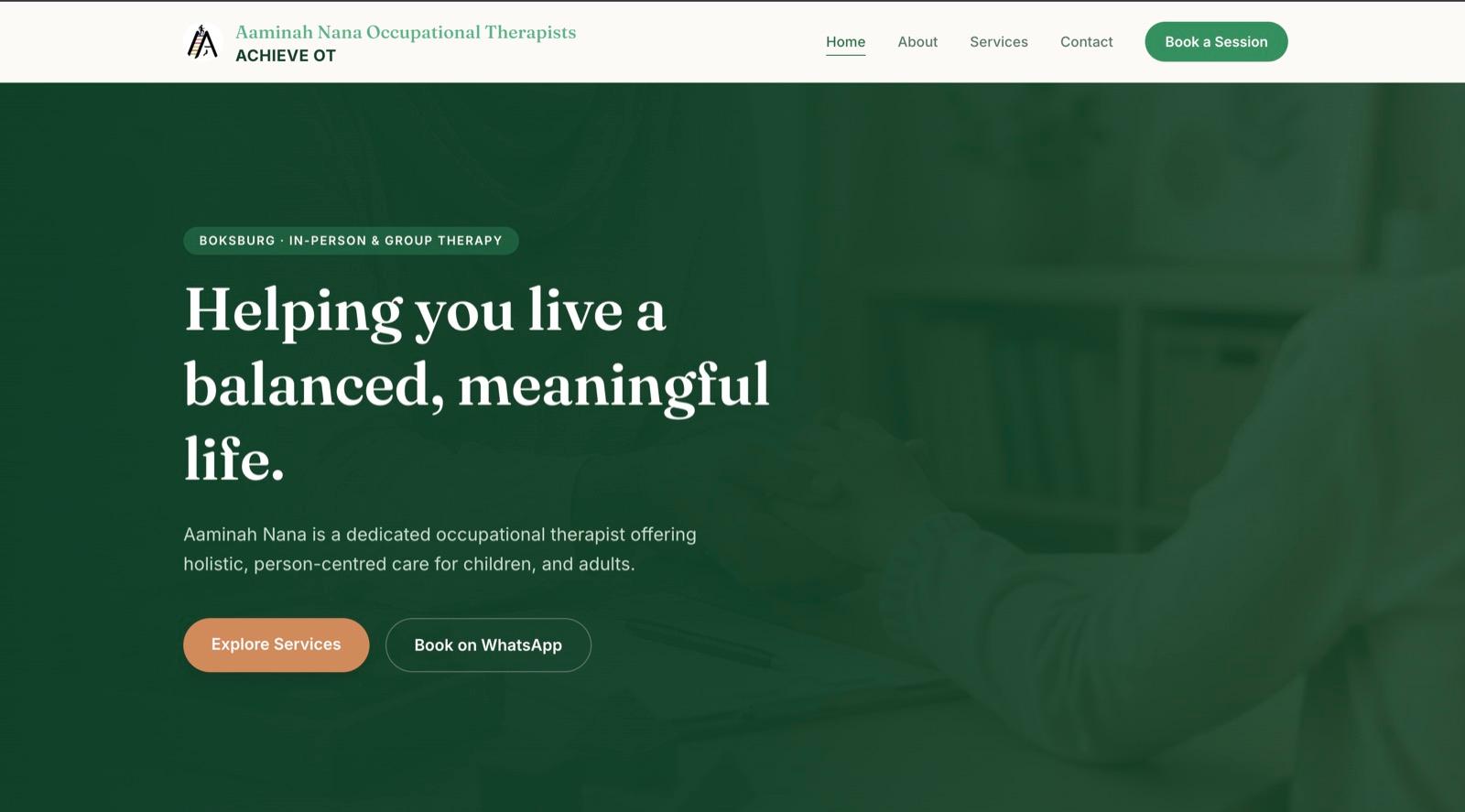
Achieve OT is the practice website for an occupational therapist. The practice had a strong reputation built entirely through referrals — and no digital presence to receive it. Anyone who heard the name and searched for it found nothing to verify.
For the business, a high-leverage front door. A service business lives or dies on trust, and trust now starts with a search result.
Before — manual
- No website — referrals had nowhere to land
- Parents and referrers could not verify the practice
- No way to enquire outside working hours
- Zero presence for a name people already trusted
After — automated
- A credible, professional front door
- Services and approach explained clearly
- An enquiry path that is open when the practice isn't — WhatsApp, email or phone
- Findable by the people already looking
What it looked like before
Nothing was broken. The practice simply had no surface area. Every referral had to be converted in person or over the phone, and anyone doing their own research before booking reached a dead end.
For a care practice, that dead end costs more than a missed booking — it costs the confidence of the person deciding whether to trust you with their child's development.
What I built
A front door built on the questions people actually ask
The structure follows the visitor's decision path rather than the practice's internal vocabulary:
- Who is this for — the first screen establishes the therapist, the discipline and the population served.
- What you can expect — what occupational therapy addresses and how sessions work.
- Why trust it — credentials, approach and tone.
- How to start — one obvious route to an enquiry.
Design that reads as professional, not clinical
Care-practice sites often drift either clinical-cold or soft-undefined. Achieve OT sits deliberately in the middle: calm typography, generous whitespace and warm restraint, so the site feels like a competent professional rather than a brochure or a form.
Built to be found
- Semantic, accessible markup so the content is legible to search engines and screen readers alike.
- Descriptive page titles and metadata written around what parents and referrers actually search for.
- Fast, mobile-first delivery — most parents will find this on a phone, often at night.
- One primary call to action repeated down the page.
What changed
The practice moved from invisible to findable. The measurable change is not traffic — it is the number of enquiries that arrive already understanding what the practice does and who it helps.
A note on sharing
This is a client's practice, so the detail here is deliberately limited: the structure, the decisions and the outcome, published with the practice's permission. Nothing about the people it treats appears anywhere on this site.